AI Agent Fundamentals
Master Agentic Reasoning: From ReAct and Chain-of-Thought to advanced Self-Reflection and Error Correction loops.
Master Agentic Reasoning: From ReAct and Chain-of-Thought to advanced Self-Reflection and Error Correction loops. This hands-on tutorial focuses on practical implementation of ai agent fundamentals concepts.
AI Agent Fundamentals
For a long time, LLMs were just "text predictors" in a box. You ask a question, they give an answer. AI Agents change everything. An agent is an LLM given Agency—the ability to use tools, maintain memory, and follow a reasoning loop to achieve a goal.
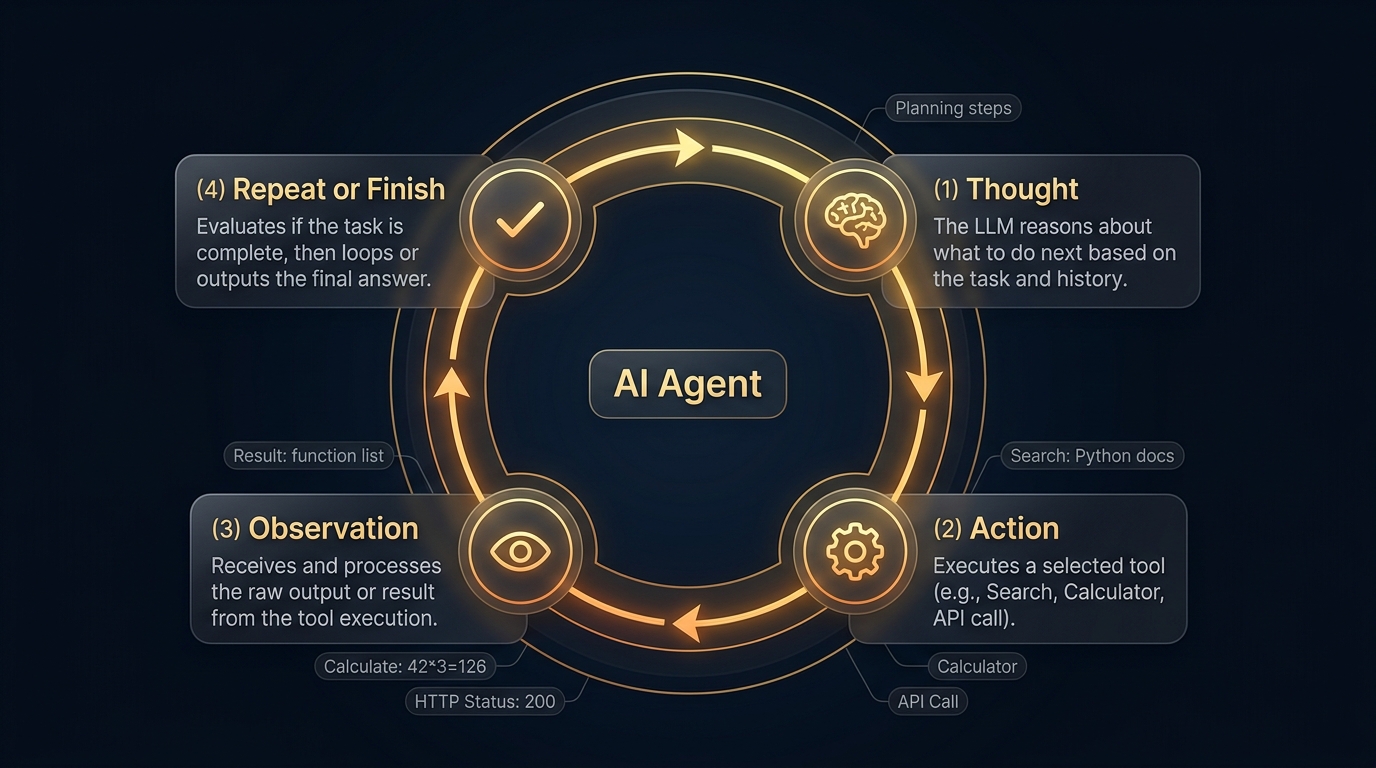
1. Core Anatomy of an Agent 🤖
While a standard LLM is like a knowledgeable librarian, an AI Agent is like a diligent assistant.
The "Brain" vs. The "Body"
- The Brain (LLM): Handles reasoning, planning, and decision-making.
- The Senses (Perception): Ingesting environment data (APIs, Files, User Context).
- The Hands (Tools): Executing actions in the real world.
- The Memory: Storing past experiences to improve future decisions.
2. Agentic Reasoning Patterns 🧠
How an agent "thinks" determines its capability. We can categorize reasoning into three main patterns:
| Pattern | Mechanism | Use Case |
|---|---|---|
| Zero-Shot Action | Directly predicts the tool call without thinking. | Simple API triggers. |
| Chain-of-Thought (CoT) | Model verbalizes internal logic before answering. | Complex math or logic. |
| ReAct (Reason + Act) | A cycle of Thought -> Action -> Observation. | Autonomous research/tasks. |
3. Advanced Strategy: Reflection & Self-Correction 🔄
One of the most powerful "In-Depth" agent patterns is Self-Reflection. Instead of stopping after the first answer, the agent reviews its own work.
The CRITIC Loop:
- Draft: Agent creates an answer.
- Review: Agent plays the role of a "Critic" and seeks mistakes or hallucinations.
- Refine: Agent updates the answer based on the critique.
4. Task Decomposition 🏗️
Complex goals like "Build a website" are too large for one reasoning step. Agents use Recursive Decomposition:
- High-Level Planning: Break the goal into 5 sub-tasks.
- Execution: Handle each sub-task one by one.
- Global Merge: Combine sub-results into the final output.
[!TIP] Plan-and-Execute architectures are often more stable than pure ReAct because the high-level plan acts as a "GPS" that keeps the agent from getting distracted by small observations.
Interactive Challenge: Trace an Agent's Thought
Observe how a ReAct agent handles a multi-step query.
AGENT indepth architectures
Quiz
Quiz
Question 1 of 3What is the primary difference between a standard LLM and an AI Agent?
AI Mentor
AssistantConfused about "AI Agent Fundamentals reasoning patterns ReAct Reflection Self-Correction"? Ask our AI mentor for a simplified explanation.
Key Takeaways
✅ Agents combine Reasoning, Perception, Tools, and Memory.
✅ ReAct loops allow for dynamic reactivity, but Plan-and-Execute offers better stability for complex goals.
✅ Self-Reflection is the "Secret Sauce" for reducing hallucinations and correcting errors.
✅ Task Decomposition handles the "too big to solve" problem.
What's Next?
We know how the brain thinks. Now let's build the hands.
Next Chapter: Tool-Using LLMs & Parallel Function Calling.