Diffusion Models
How AI creates images from noise. Explore the science of Denoising, Latent Diffusion, and the CLIP model that bridges text and pixels.
How AI creates images from noise. Explore the science of Denoising, Latent Diffusion, and the CLIP model that bridges text and pixels. This hands-on tutorial focuses on practical implementation of diffusion models concepts.
Diffusion Models
If Large Language Models (LLMs) are the masters of text, Diffusion Models are the masters of imagery. Models like Stable Diffusion, Midjourney, and DALL-E 3 have forever changed how we think about visual art and design.
1. The Core Idea: Generating Order from Chaos 🌪️
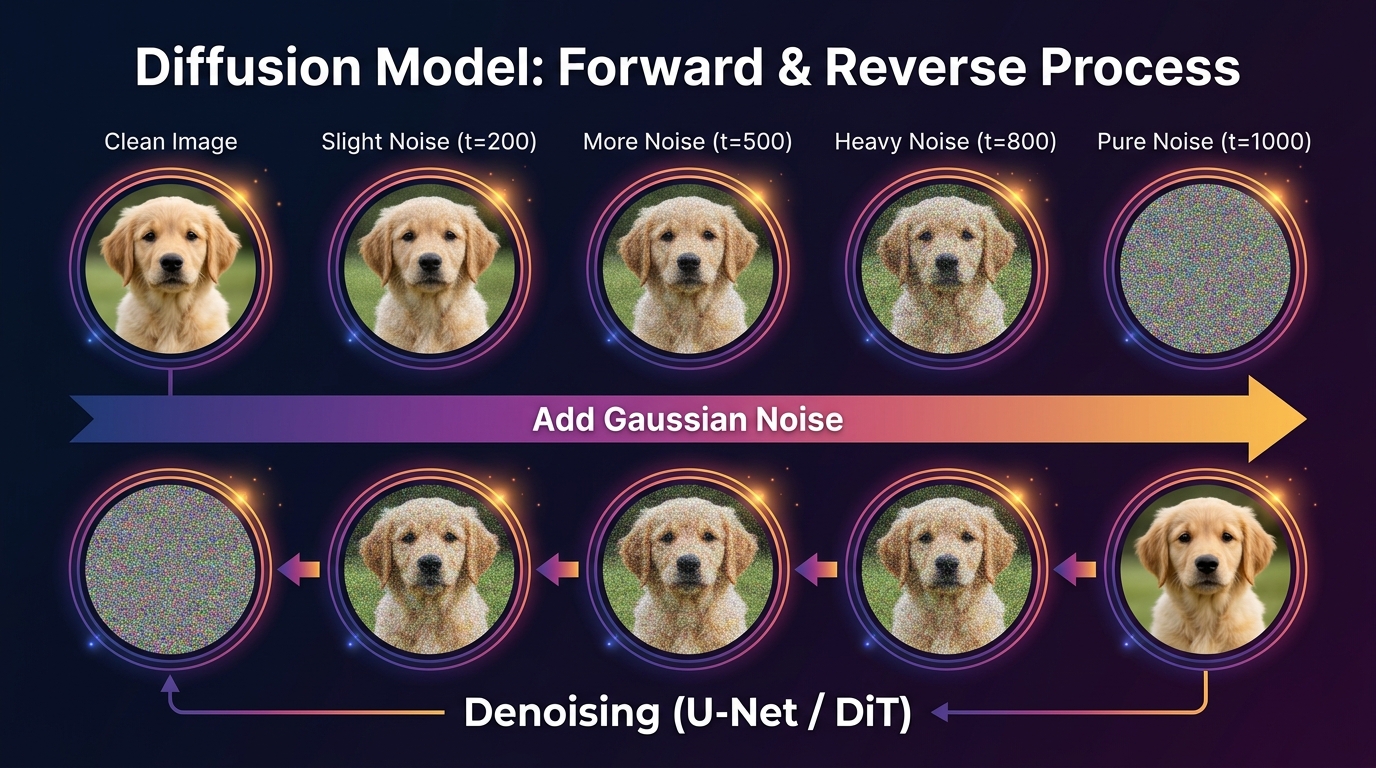
The fundamental intuition behind diffusion models is simple yet brilliant: Destruction and Reconstruction.
- Forward Diffusion (Destruction): Take a clear image and slowly add random Gaussian noise to it over several steps until it becomes pure static.
- Reverse Diffusion (Reconstruction): Train a neural network (typically a U-Net) to predict how much noise was added at each step and remove it.
By learning to "clean" noise, the model learns how to construct images from scratch.
2. Latent Diffusion: Working in Secret Code 🕵️♂️
Generating high-resolution images pixel-by-pixel is incredibly slow and expensive. Latent Diffusion (the technique used by Stable Diffusion) solves this by working in a compressed space called Latent Space.
Instead of working with a 512x512 image (786,432 values), the model works with a compressed "latent" version (e.g., 64x64). This makes it 10x to 100x faster.
The Standard Components
| Component | Role |
|---|---|
| VAE (Variational Autoencoder) | Compresses image to Latent Space and decodes it back to pixels. |
| U-Net | The "brains" that predicts and removes noise from the latents. |
| CLIP Text Encoder | Turns your prompt into vectors the U-Net can understand. |
3. CLIP: The Bridge between Text and Images 🌉
How does the U-Net know that your prompt "A neon cat in space" means it should generate stars and glowing whiskers?
The answer is CLIP (Contrastive Language-Image Pre-training). CLIP was trained on millions of (image, caption) pairs. It learned to map the concept of "cat" and the visual of a cat into the same mathematical space.
4. Prompt Engineering & Sampling 🎨
When you generate an image, you can control the outcome using various settings:
- CFG Scale (Classifier-Free Guidance): How hard the model should try to follow your prompt. Higher = more literal but can get distorted.
- Steps: How many times the model should perform the denoising step. (Typically 20-50).
- Schedulers (Samplers): The mathematical algorithm used to subtract the noise (e.g., Euler a, DPM++).
Quiz
Quiz
Question 1 of 3What is the primary role of the U-Net in a diffusion model?
AI Mentor
AssistantConfused about "Diffusion models U-Net VAE CLIP Stable Diffusion"? Ask our AI mentor for a simplified explanation.
Key Takeaways
✅ Diffusion models create images by reversing a noisy process.
✅ Latent Diffusion makes generation efficient by working in a compressed space.
✅ CLIP provides the semantic guidance that makes text-to-image possible.
✅ The U-Net is the core architecture responsible for denoising.
What's Next?
Text and images are just the beginning. How can we generate fluid videos, immersive audio, and 3D worlds?
Next: Image, Audio & Video Generation.