Advanced RAG Patterns
Beyond Naive RAG: Master Self-Correction, HyDE, Multi-Query Retrieval, Contextual Retrieval, GraphRAG, Reranking, and RAGAS for high-precision data chat.
Beyond Naive RAG: Master Self-Correction, HyDE, Multi-Query Retrieval, Contextual Retrieval, GraphRAG, Reranking, and RAGAS for high-precision data chat. This hands-on tutorial focuses on practical implementation of advanced rag patterns concepts.
Advanced RAG Patterns
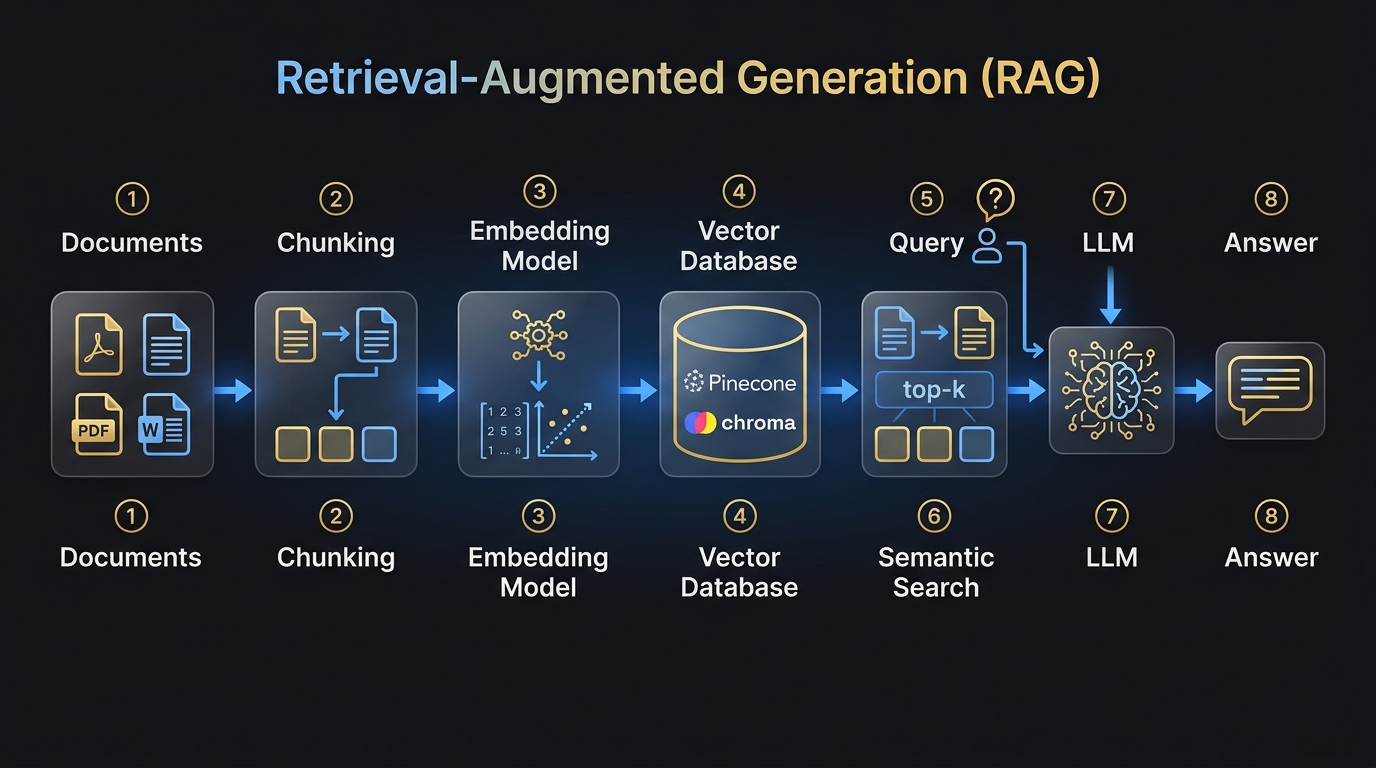
Simple RAG (Vector Search → LLM) is often called "Naive RAG". In production, it often fails because search results are messy or irrelevant. To build a world-class system, we need Agentic RAG — systems that can think, verify, and try again.
1. Query Transformation: Fixing the Question 🪄
Often, the user's question is poorly phrased for a search engine. We can use an LLM to rewrite it:
- Multi-Query Retrieval: Generate 5 different versions of the same question and search for all of them. This increases "recall".
- HyDE (Hypothetical Document Embeddings): The LLM writes a "fake" answer first. We then use that fake answer to search for a real document. Surprisingly, this works better than searching with a question!
- Sub-Question Decomposition: Break a complex question ("Compare Python vs Java in 2024") into two searches ("Python in 2024" and "Java in 2024").
2. Corrective RAG (CRAG) & Self-RAG 🛡️
What if the documents retrieved are completely useless? Naive RAG will just hallucinate an answer. Advanced RAG evaluates the quality.
- Retrieve: Get top 5 documents.
- Evaluate: A specialized "Grader" LLM checks if the documents are relevant.
- Correct:
- If Relevant: Proceed to generation.
- If Irrelevant: Trigger a Web Search tool to find better info.
- If Ambiguous: Use Reranking.
3. Reranking: Quality over Quantity 🏆
Vector search might return the top 100 documents quickly, but only top 3 fit in the prompt. Cross-Encoders (Rerankers) like Cohere or BGE are specialized models that look at the query and document together to give an absolute relevance score.
[!IMPORTANT] Reranking is the easiest way to improve RAG accuracy. It filters out the "noise" that semantic search often pulls in.
📚 Official Docs
- Cohere Rerank API — Production reranking service
- LangChain RAG Tutorial — End-to-end RAG pipeline
- LlamaIndex RAG Guide — Advanced query engines
4. Anthropic Contextual Retrieval 🔍
A major problem with naive RAG: chunks lose their context when split from the document.
"The defendant was found guilty." — What case? What crime? Out of context, this chunk is useless.
Anthropic's Contextual Retrieval prepends a short context summary to each chunk before embedding it:
📚 Official Resource
5. Microsoft GraphRAG: Knowledge Graph + RAG 🕸️
Standard RAG retrieves relevant documents. GraphRAG builds a knowledge graph from your documents and enables queries that cross-reference entities and relationships:
When to use GraphRAG vs. Standard RAG:
- Standard RAG: "What does the contract say about payment terms?" → Local chunk retrieval
- GraphRAG: "What are the main themes across all 500 contracts?" → Global graph traversal
📚 Official Resource
6. RAGAS: Scientific Evaluation Framework 📊
How do you know if your RAG is 80% or 90% accurate? We use the RAG Triad with RAGAS:
📚 Official Docs
- RAGAS Documentation — RAG evaluation framework
- RAGAS GitHub — Open-source implementation
7. RAG vs. Fine-Tuning: Decision Framework 🔀
| Factor | Use RAG | Use Fine-Tuning |
|---|---|---|
| Data changes frequently | ✅ Update vector DB | ❌ Requires retraining |
| Need source citations | ✅ Natural fit | ❌ Hard to trace |
| Need specific tone/style | ❌ Hard to enforce | ✅ Baked into weights |
| Large proprietary knowledge base | ✅ Scalable | ❌ Context size limits |
| Low latency required | ⚠️ Extra retrieval step | ✅ Faster inference |
Quiz
Quiz
Question 1 of 3What is HyDE (Hypothetical Document Embeddings)?
Key Takeaways
✅ Query Transformations (Multi-query, HyDE, Sub-questions) fix bad search results at the source.
✅ Corrective RAG (CRAG) adds a validation step to prevent hallucinations when retrieval fails.
✅ Reranking (Cohere, BGE) is the "silver bullet" for improving precision.
✅ Contextual Retrieval prepends context to chunks before embedding — reduces failures by 49%.
✅ GraphRAG enables global knowledge synthesis across large document collections.
✅ RAGAS provides a scientific, automated way to evaluate RAG quality.
Official Resources
- 📖 LangChain RAG Tutorial
- 📖 LlamaIndex RAG Guide
- 📖 RAGAS Documentation
- 📖 Microsoft GraphRAG
- 📖 Anthropic Contextual Retrieval
What's Next?
RAG relies on the Vector DB. But how do you handle billions of items without crashing?
Next Chapter: Vector Database Deep Dive: HNSW, Quantization, and Platform Selection.