Transformers & Attention
The architecture that changed the world. Master Self-Attention, Multi-Head Attention, Flash Attention, KV-Cache, Rotary Positional Encodings, and why 'Attention Is All You Need'.
The architecture that changed the world. Master Self-Attention, Multi-Head Attention, Flash Attention, KV-Cache, Rotary Positional Encodings, and why 'Attention Is All You Need'. This hands-on tutorial focuses on practical implementation of transformers & attention concepts.
Transformers & Attention
In 2017, Google researchers published a paper titled "Attention Is All You Need". It introduced the Transformer architecture, which eliminated RNNs and became the foundation for every modern LLM (GPT, BERT, Claude, LLaMA).
[!TIP] Read the original paper — "Attention Is All You Need" (Vaswani et al., 2017). One of the most important papers in AI history.
1. The Problem with RNNs 🐢
- Sequential: Must process word 1, then word 2, then word 3. Slow! Cannot be parallelized on modern GPUs.
- Long-term Memory: Struggled with very long contexts — the gradient signal vanishes over many steps.
- Bottleneck: The entire sequence was compressed into a fixed-size context vector, losing information.
2. The Solution: Self-Attention 💡
Transformers process the entire sentence at once (parallelization). The core mechanism is Self-Attention — it allows every token to look at every other token to figure out context.
- Sentence: "The animal didn't cross the street because it was too tired."
- Attention: When the model processes "it", it pays high attention to "animal" and low attention to "street".
The Math of Self-Attention
Each token gets projected into three vectors:
- Query (Q): "What information am I looking for?"
- Key (K): "What information do I have?"
- Value (V): "What is the actual content I'll share?"
The attention formula:
Attention(Q, K, V) = softmax(QK^T / √d_k) × V
QK^T— Dot product gives a score: how much does each query "match" each key?/ √d_k— Scaling prevents the scores from getting too large (causes softmax to saturate)softmax(...)— Converts scores to probabilities (0 to 1, sum to 1)× V— Weight the value vectors by attention scores
3. Multi-Head Attention (MHA) 🎯
Instead of running attention once, we run it h times in parallel (multiple "heads"), each learning different types of relationships:
- Head 1: Might learn syntactic relationships (subject-verb agreement)
- Head 2: Might learn coreference (pronoun → noun it refers to)
- Head 3: Might learn semantic similarity (synonyms, antonyms)
MultiHead(Q, K, V) = Concat(head_1, ..., head_h) × W_O
where head_i = Attention(Q × W_Q_i, K × W_K_i, V × W_V_i)
GPT-3 uses 96 attention heads with 128-dimensional each (96 × 128 = 12,288 total model dimension).
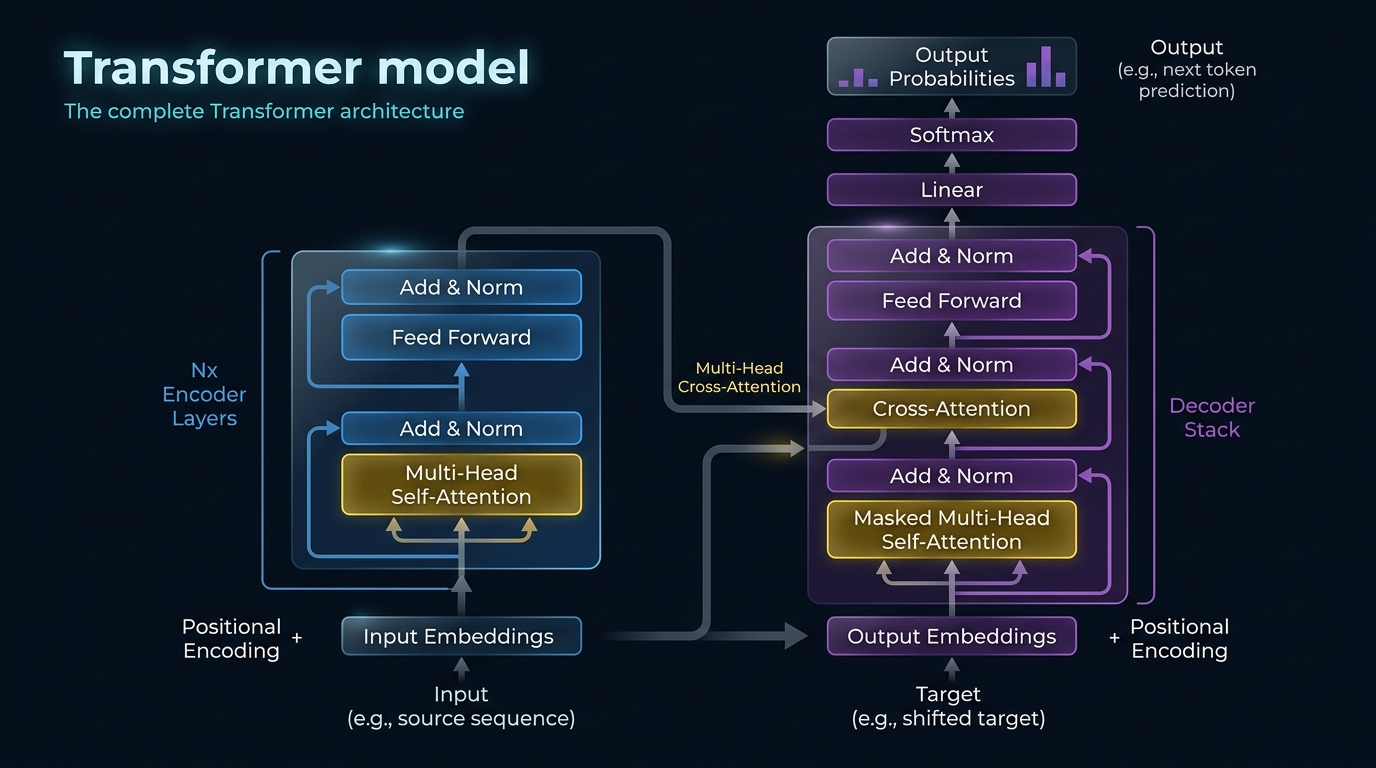
4. Architecture: Encoder-Decoder 🏗️
The original Transformer had two parts:
- Encoder: Reads the input and builds rich contextual representations.
- Decoder: Generates the output, attending to both its own previous outputs and the encoder's output.
- BERT (Encoder-only): Good for understanding (Classification, NER, Search). Can see all tokens bidirectionally.
- GPT (Decoder-only): Good for generation (Chatbots, Writing). Uses causal masking — each token can only attend to previous tokens.
- T5/BART (Encoder-Decoder): Good for transformation (Translation, Summarization).
5. Positional Encoding 📍
Since Transformers process all words at once, they don't inherently know the order of words. We must inject position information.
Absolute Positional Encodings (Original Transformer)
Add a sinusoidal vector based on position number:
PE(pos, 2i) = sin(pos / 10000^(2i/d_model))
PE(pos, 2i+1) = cos(pos / 10000^(2i/d_model))
Rotary Position Embeddings (RoPE) — Used by LLaMA, GPT-NeoX
RoPE encodes position by rotating the query and key vectors. This naturally captures relative positions rather than absolute ones.
- Advantage: Better generalization to sequence lengths not seen during training.
- Used by: LLaMA 2/3, Mistral, Falcon, GPT-NeoX, Phi.
📚 Official Resources
- RoPE Paper — Original Rotary Embeddings paper
- Jay Alammar: Illustrated Transformer — Best visual explanation
6. KV-Cache: The Secret to Fast Inference ⚡
During generation, the model processes the same past tokens repeatedly. KV-Cache stores the Key and Value matrices from previous steps so they don't need to be recomputed:
7. Flash Attention: Making It Practical at Scale ⚡
The bottleneck in standard attention is memory bandwidth — writing and reading the large N×N attention matrix from GPU HBM (high-bandwidth memory).
Flash Attention (Tri Dao et al., 2022) reorganizes the computation to keep intermediate results in the fast SRAM (on-chip cache):
- 2-4x faster training
- 10-20x less memory for the attention matrix
- Enables long contexts (32K, 128K, 1M tokens) that weren't previously possible
[!IMPORTANT] Flash Attention is now used by virtually all major LLM training runs. It's the reason models can have 128K+ token context windows.
📚 Official Resources
- Flash Attention Paper — Original Flash Attention
- Flash Attention 2 GitHub — Production implementation
Interactive Challenge: Attention Matrix
Imagine we have 3 words. The Attention Matrix shows how much each word focuses on others.
Quiz
Quiz
Question 1 of 4Why are Transformers faster to train than RNNs?
Key Takeaways
✅ Self-Attention uses Q, K, V projections to let every token attend to every other token.
✅ Multi-Head Attention runs multiple attention operations in parallel, each learning different linguistic patterns.
✅ KV-Cache makes autoregressive generation efficient by storing past computations.
✅ Flash Attention tiles the attention computation to use fast on-chip memory, enabling 128K+ context windows.
✅ RoPE positional encodings (used in LLaMA, Mistral) generalize better than absolute sinusoidal encodings.
Official Resources
- 📖 "Attention Is All You Need" Paper
- 📖 Flash Attention Paper
- 📖 Flash Attention 2 GitHub
- 📖 Jay Alammar: Illustrated Transformer
- 📖 RoPE Paper
What's Next?
We have the building blocks. Now let's scale it up. Way up. Next Chapter: Large Language Models (LLMs) — Deep Dive.