What is Artificial Intelligence?
Understand the basics of AI, the difference between AI, ML, and Deep Learning, and explore real-world applications.
Understand the basics of AI, the difference between AI, ML, and Deep Learning, and explore real-world applications. This hands-on tutorial focuses on practical implementation of what is artificial intelligence? concepts.
What is Artificial Intelligence?
Artificial Intelligence (AI) is no longer science fiction. It's in your phone, your car, and your web browser. But what exactly is it?
At its core, AI is the simulation of human intelligence processes by machines, especially computer systems. These processes include learning, reasoning, and self-correction.
1. The AI Hierarchy 🧠
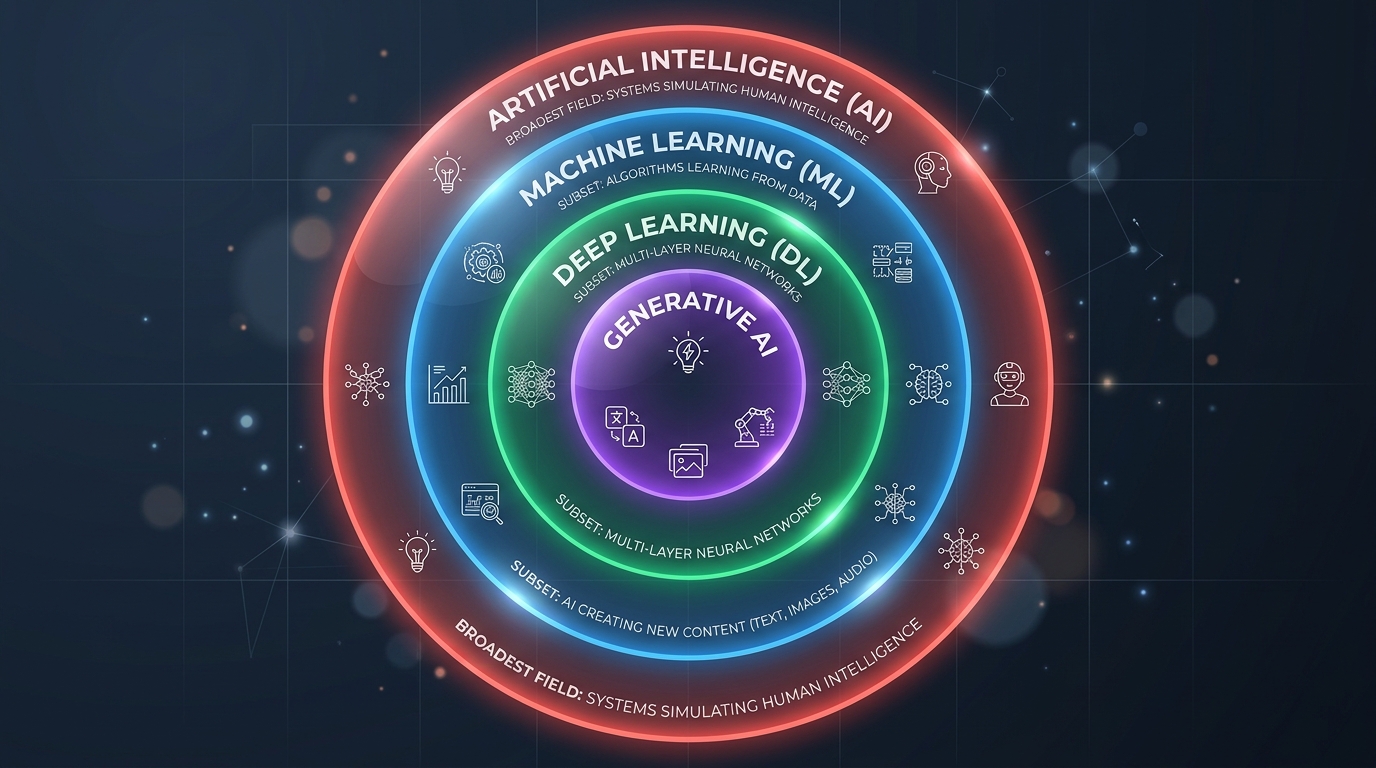
People often use AI, Machine Learning (ML), and Deep Learning (DL) interchangeably, but they are different. Think of them as Russian nesting dolls:
- Artificial Intelligence (AI): The broad umbrella. Any technique that enables computers to mimic human behavior.
- Machine Learning (ML): A subset of AI. Algorithms that allow computers to learn from data without being explicitly programmed.
- Deep Learning (DL): A subset of ML. Uses neural networks with many layers (hence "deep") to learn from vast amounts of data.
2. Narrow AI vs. General AI 🤖
-
Artificial Narrow Intelligence (ANI): AI designed for a specific task.
- Examples: Siri, Google Search, Chess bots, Face ID.
- Status: We are here.
-
Artificial General Intelligence (AGI): AI that possesses the ability to understand, learn, and apply knowledge across a wide variety of tasks, much like a human.
- Examples: JARVIS (Iron Man), C-3PO (Star Wars).
- Status: Theoretical / Future.
3. Real-World Examples 🌍
You interact with AI every day:
- Recommendation Systems: Netflix suggesting movies, Amazon suggesting products.
- Computer Vision: Tesla Autopilot detecting lanes, Medical imaging detecting tumors.
- Natural Language Processing (NLP): ChatGPT, Google Translate, Spam filters.
- Generative AI: Midjourney creating art, GitHub Copilot writing code.
4. Common Myths 🚫
| Myth | Reality |
|---|---|
| "AI will replace all humans." | AI replaces tasks, not necessarily jobs. It augments human capabilities. |
| "AI is objective and unbiased." | AI learns from human data, which contains human biases. |
| "You need a PhD to do AI." | Modern tools and APIs make AI accessible to all developers. |
Quiz
Quiz
Question 1 of 3Which of the following is the broadest term?
AI Mentor
AssistantConfused about "Artificial Intelligence AI Machine Learning Deep Learning Generative AI hierarchy ANI AGI"? Ask our AI mentor for a simplified explanation.
Key Takeaways
✅ AI is the broad goal of simulating intelligence.
✅ ML is how we achieve AI (learning from data).
✅ ANI (Narrow AI) is what we have today; AGI is the future goal.
✅ AI is already everywhere, from your phone to your car.
What's Next?
Now that we know what AI is, let's understand the fuel that powers it: Data.
Next Chapter: Data, Algorithms & Models.