SQL vs NoSQL
Master the fundamental differences between SQL and NoSQL databases, understand ACID vs BASE properties, explore NoSQL categories (Key-Value, Document, Column-Family, Graph), and learn when to use PostgreSQL vs MongoDB vs Cassandra vs DynamoDB vs Neo4j.
Master the fundamental differences between SQL and NoSQL databases, understand ACID vs BASE properties, explore NoSQL categories (Key-Value, Document, Column-Family, Graph), and learn when to use PostgreSQL vs MongoDB vs Cassandra vs DynamoDB vs Neo4j. This hands-on tutorial focuses on practical implementation of sql vs nosql concepts.
SQL vs NoSQL
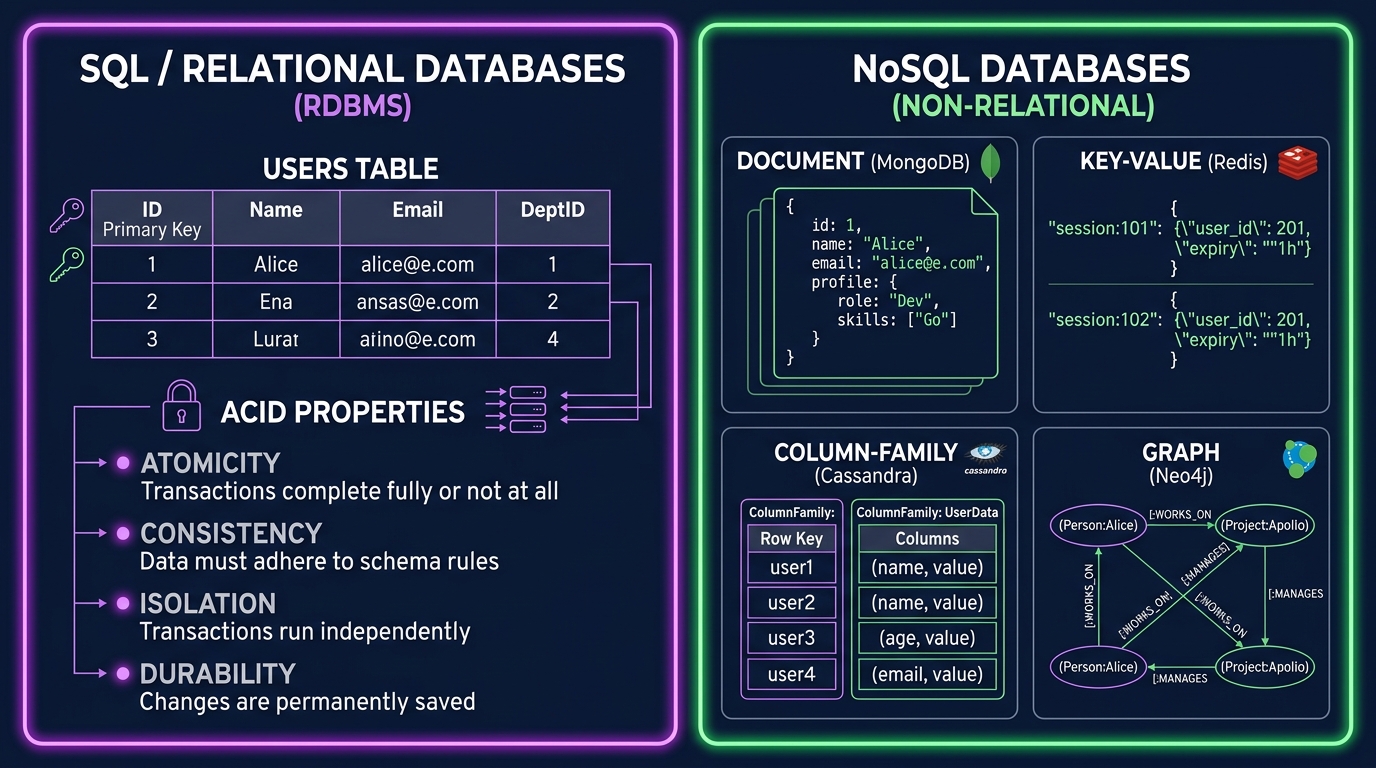
Choosing the wrong database type is one of the most expensive architectural mistakes you can make — it requires a full data migration later. The SQL vs NoSQL decision must be made based on your data model, access patterns, and consistency requirements — not hype.
[!IMPORTANT] There is no universally "better" database. The right answer depends entirely on your access patterns, consistency requirements, and scale. Most production systems use multiple databases for different parts of the same application.
Core Differences
| Property | SQL (Relational) | NoSQL |
|---|---|---|
| Schema | Fixed, enforced | Flexible / schema-less |
| Relationships | Foreign keys, JOINs | Embedded docs or app-level joins |
| Consistency | ACID (strong) | BASE (eventual, configurable) |
| Scaling | Vertical (primarily) | Horizontal (designed for it) |
| Query power | Rich SQL, any query | Optimized for known access patterns |
| Best for | Complex relations, transactions | High write throughput, flexible schema |
ACID vs BASE
NoSQL Database Categories
1. Key-Value Stores
Redis, DynamoDB, Memcached — Simplest model: a dictionary at massive scale.
Best for: Session storage, caching, shopping carts, leaderboards.
2. Document Databases
MongoDB, CouchDB, Firestore — Store JSON-like documents with flexible schema.
Best for: User profiles, product catalogs, content management, real-time apps.
3. Wide-Column (Column-Family) Stores
Cassandra, HBase, Bigtable — Rows with dynamic columns, optimized for time-series and write-heavy workloads.
Best for: Time-series data, IoT sensor data, messaging systems, activity feeds.
4. Graph Databases
Neo4j, Amazon Neptune, ArangoDB — Data modeled as nodes and edges (relationships).
Best for: Social networks, fraud detection, recommendation engines, knowledge graphs.
Decision Framework: When to Use Which Database
| Database | Best For | Real-World Users |
|---|---|---|
| PostgreSQL | Complex queries, financial data, general purpose | Instagram, Airbnb, GitHub |
| MongoDB | Flexible documents, rapid iteration | eBay, Forbes, Foursquare |
| Cassandra | Write-heavy, time-series, massive scale | Netflix, Discord, Uber |
| DynamoDB | Serverless, auto-scaling, key-value at AWS scale | Amazon, Lyft, Samsung |
| Redis | Caching, sessions, real-time leaderboards | Twitter, GitHub, Stack Overflow |
| Neo4j | Social graphs, fraud detection, recommendations | LinkedIn, Walmart, NASA |
Quiz
Quiz
Question 1 of 2A banking application needs to transfer money between accounts. Which database property ensures that if the debit succeeds but the credit fails, the debit is also rolled back?
Key Takeaways
✅ Use PostgreSQL as your default — it handles 95% of use cases with ACID guarantees and full SQL power.
✅ Use Cassandra when you have >100M writes/day and a fixed, well-defined access pattern.
✅ Use Redis for caching, sessions, and real-time data — never as your primary database.
✅ Use MongoDB when your schema evolves rapidly or you're storing heterogeneous documents.
✅ Denormalization (duplicating data) is normal in NoSQL — it trades storage for query performance.
Official Resources
- 📖 PostgreSQL Documentation — The most complete SQL database docs
- 📖 MongoDB Documentation — Document modeling, aggregation pipeline
- 📖 Apache Cassandra Documentation — Data modeling guide is essential reading
- 📖 DynamoDB Developer Guide — Single-table design patterns
What's Next?
Now that you know which database type to choose, the next challenge is: what happens when a single database server can't handle your data volume?
Next: Database Sharding & Partitioning — How to split your data across multiple servers.